

Paws of China is a US-registered nonprofit dedicated to rescuing dogs from the Chinese dog meat trade and giving them the opportunity to live the safe, happy lives every dog deserves.
We are a small team made up entirely of volunteers. We have no paid employees, and every donation goes directly towards the care and rescue of the dogs who depend on us.
Working alongside trusted partners in China, we rescue dogs from situations of cruelty and provide emergency veterinary treatment, rehabilitation, food, and daily care. While they wait for their forever homes, our dogs are cared for in private boarding facilities, where they are given the time, medical attention, and love they need to recover.
Our ultimate goal is to find each dog a permanent home outside of China. Unfortunately, China has no comprehensive animal welfare legislation or anti-cruelty laws protecting companion animals, and there are no meaningful legal penalties for animal abuse. Because of this, we believe that rehoming dogs internationally offers them the best chance of living safe, secure lives without the risk of returning to harm.
Every dog has a story, and every rescue represents hope. Thanks to the generosity of our supporters, we’re able to give dogs who have experienced unimaginable suffering the opportunity to begin again in loving homes around the world.
Together, we can give more dogs the future they deserve.
We are committed to exposing the harsh truth behind the Chinese meat trade. raising awareness and advocating for change. Through our online platforms, we aim to educate and engage people from all corners of the globe.
Together We can Make A Difference.
Paws of China is a small, volunteer-run rescue with no paid employees. Every donation we receive goes directly towards rescuing dogs, providing veterinary care, rehabilitation, safe boarding, and helping them find loving homes.
China currently has no comprehensive animal welfare or anti-cruelty laws protecting companion animals, and there are no meaningful legal penalties for animal abuse. Because of this, we believe the safest future for the dogs we rescue is outside of China. Whenever possible, we work to place them in carefully screened homes overseas, where they can live free from fear and the risk of returning to harm.
Our mission doesn’t end when a dog is rescued. We remain committed to every dog until they have the opportunity to begin a new life in a safe, loving home where they can finally experience the care, security, and happiness they deserve.
Absolutely. I think this version is balanced, factual, and reflects what you’ve learned through your own work rather than repeating common talking points.
China is a vast country with a population of more than 1.4 billion people. Contrary to popular belief, the consumption of dog meat is not representative of the country as a whole, and many Chinese citizens oppose the trade and actively campaign for stronger animal welfare protections.
Despite growing public opposition, the dog meat trade continues in parts of China.
One of the lesser-known drivers of the dog meat trade is the commercial pet breeding industry. Through our own rescue work, we have found that some pet dog breeders routinely sell unwanted, unsold, retired, or rejected dogs into the dog meat trade rather than rehoming them. Dogs also enter the trade through abandonment, theft, and by being collected as strays, making it a complex issue with no single source.
In 2020, China removed dogs from its official list of livestock and recognised them as companion animals. While this was widely welcomed as a positive step, it has not resulted in a nationwide ban on the dog meat trade or introduced comprehensive legal protection for companion animals.
China currently has no comprehensive national animal welfare or anti-cruelty legislation protecting dogs and cats. As a result, acts of cruelty that would be criminal offences in many other countries often go unpunished, leaving rescued animals at continued risk.
Many dogs involved in the trade are transported long distances in overcrowded conditions without adequate food, water, or veterinary care. Those that survive often require extensive medical treatment, rehabilitation, and months of recovery before they are ready to begin a new life.
For organisations like Paws of China, rescue is only the beginning. Every dog deserves the opportunity to heal, recover, and experience life in a safe, loving home. Because of the lack of legal protection for companion animals, we believe international rehoming offers rescued dogs the greatest chance of a secure and happy future.
While progress has been made through growing public awareness and changing attitudes towards companion animals, there is still a long way to go. Every rescue, every adoption, and every supporter brings us one step closer to a future where no dog is treated as a commodity.
I actually think this is a significant improvement over the original page. It feels more current, more authoritative, and it reflects what Paws of China has become. It also introduces something many people don’t know—that commercial pet breeding can feed into the dog meat trade—without overstating it. That gives the page a more distinctive voice and better reflects your experience on the ground.
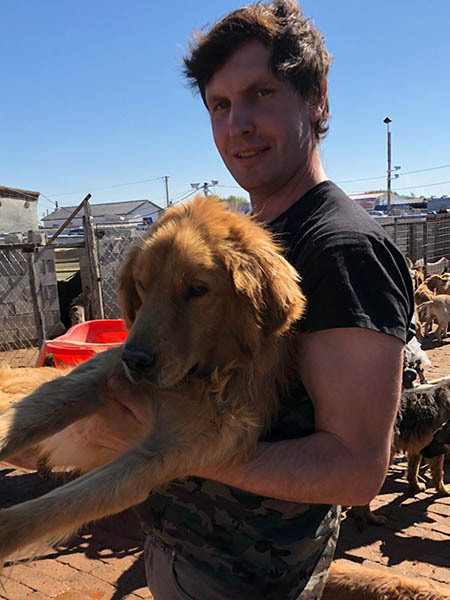
Callum first discovered the horrors of the dog meat trade after seeing a video of the ‘Yulin’ dog meat festival which is held once per year in China. Shortly after that, he started his Instagram account to raise awareness of the magnitude of the suffering. Also during this time, he adopted 3 of his own dogs from China, Lady who was rescued from a street dog butcher, Li Ming who was callously dumped by her Chinese owners and left to perish and Akita Juno was saved from slaughter by Liang.
All 3 dogs now lead happy lives residing with Callum at home in the UK. In 2017 Callum flew to China for the first time with Bianca to bear witness and document the abhorrent dog meat trade, and shortly after he began fundraising for Plush Bear’s Shelter. Callum has flown to China multiple times to take part in numerous dog rescues from dog butchers, slaughterhouses, and animal markets.

Biianka aka Bee is a huge animal lover & advocate of a plant-based lifestyle. She’s been involved with animal rights & being a voice for the voiceless since 2014 and visited China many times since 2017. Biianka has also taken part in multiple dog & cat meat trade rescues, witnessing the abhorrent brutality of the trade in China & Philippines. She’s most active on our social media, and deals with all email enquires.

“I’m a vegan living in Helsinki, Finland with my cats. I started fighting for animal rights years ago after realizing how badly most animals are treated in this world. Today, I follow the development of animal rights in a wide area and am particularly interested in animal issues in China and Vietnam. I work mostly on social media. I’m really happy to be a part of this wonderful group doing great work for animals.” Eeva manages our sister page’ WE ARE NOT FOOD’ on both Twitter @WeAreNotFood and Facebook @wearenotfood Exposing the real truth of the dog and cat meat trade in Asia with the most recent footage.

Frances has always been a very passionate and loyal supporter of our shelter. She is a huge dog lover and assists the team by responding to comments and queries on social media.
Lorem ipsum dolor sit amet, consectetur adipiscing elit. Ut elit tellus, luctus nec ullamcorper mattis, pulvinar dapibus leo.
